
A Guide to Spotting Energy Scams in Alameda and San Joaquin County
Energy scams can happen door-to-door, over the phone, or via email. Whether the scammer is trying to steal your information or pressure you into signing a bad contract, it’s important to know what to look for so you can protect yourself.
This guide covers common types of energy scams in San Joaquin County and Alameda County and what to do if you’re targeted.
Ava never goes door-to-door.
We will never show up at your home unannounced to sell, enroll, or promote our programs. If someone comes to your door claiming to represent Ava, do not give them your information. Please notify Ava’s customer support center at 833-699-3223 to help protect your neighbors from their activities.
Here’s what else Ava never does:
• Ask you to sign a contract to receive our electricity service
• Pressure you to make a same-day decision
• Request payment in cash, gift cards, or prepaid debit cards
• Try to sell you an appliance or gas service
Ava may communicate by mail, email, and phone. If you’re ever unsure whether a message or call is really from us, contact us directly to verify. We’ll never ask you to take an immediate action without verifying.
Fraud Scams
These are criminal scams designed to steal your money or personal information. The right response is simple: don’t engage, and report it.
Types of Fraud Scams
Impersonation
Someone claims to represent Ava, PG&E, or a government program to gain access to your home or your account information. Ava does not send field representatives to your door. PG&E may send technicians for meter checks or grid maintenance, but they carry photo ID and can be verified by calling PG&E at the number on your bill.
Shutoff threats
A caller, or someone via text or email, tells you your power will be turned off unless you pay immediately, often requesting gift cards or a prepaid debit card. Neither Ava nor PG&E demands same-day payment by phone. Shutoff notices always come by mail from PG&E first.
Account takeover (also known as “slamming”)
A third-party supplier uses your account information to switch your electricity service without your knowledge. Never share your PG&E account number with anyone who contacts you unsolicited.
Hang up or walk away if you notice:
- Requests for payment in cash, gift cards, or prepaid debit cards
- Claims to represent Ava, PG&E, or a government agency without verifiable credentials
- Requests for your account number, Social Security number, or banking information
- Pressure to act before you’ve had time to think
Predatory Sales Scams
This category is harder to spot because it often involves real, licensed companies doing things that may be legal, but are designed to work against you. Salespeople often target residents door-to-door for solar installations, home batteries, and third-party gas supply. They may represent themselves as being from Ava, PG&E, your building, or a government program.
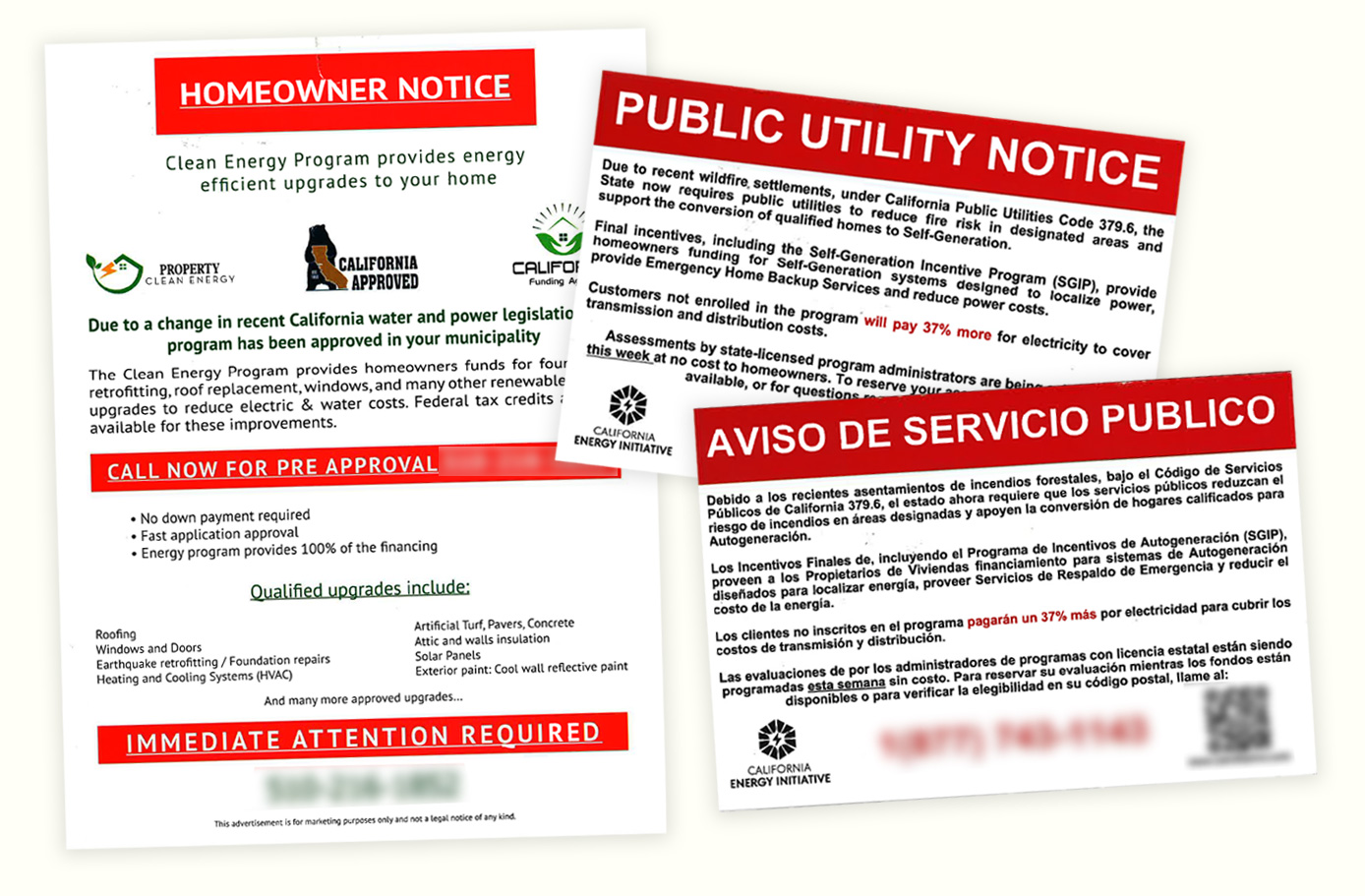
Common Tactics to Watch For
Demanding to enter your home without a scheduled appointment
A legitimate technician or installer does not show up unannounced and ask to come inside. If someone is pressuring you to let them in, you are not obligated to do so. You can call 911 if you feel unsafe.
Promises of free equipment or full government coverage
There are very few programs that offer no-cost solar installation, and they are all listed on the CPUC website. Otherwise, no legitimate program provides solar panels or home batteries entirely for free. Honest installers tell you exactly what the system will cost, what incentives or rebates may apply, and what you’ll actually owe. Anyone claiming otherwise is misrepresenting the program. If it sounds too good to be true, it probably is.
High-pressure sales tactics and obscured contracts
A salesperson asks you to sign an agreement on a tablet immediately without showing you the full terms, or tells you the offer expires today. This is a sales tactic, not a deadline. You have the right to read any contract in full before signing, and under California and federal law, you have three days to cancel a contract signed at your home. A legitimate installer will tell you this.
Introductory rates that increase over time
Some contracts start with lower payments that quietly escalate over the life of the agreement. Read the payment schedule carefully and ask what your maximum monthly payment could be.
Large upfront deposits
A significant deposit before any work begins can signal a company that won’t be around to finish the job. Legitimate providers work with you on financing without requiring large cash payments up front.
Claiming it’s mandatory
A salesperson tells you that signing up is a neighborhood requirement, that everyone in your building has to do it, or that you’ve been selected for a mandatory program. No energy enrollment is mandatory. Legitimate providers give you a choice.
Note on Ava programs: Ava partners with qualified, trained installers to offer customer programs like SmartHome Battery. Those partners carry credentials, explain costs clearly in writing, and will always give you time to review the details before you decide anything. A legitimate, qualified installer will never pressure you, promise free equipment, or ask to enter your home without your full and informed prior consent.
Know Your Rights and Protect Yourself
Under California and federal law, you have the right to cancel most contracts signed at your home within three business days. This is called the “cooling-off period.” A trustworthy installer will explain this to you before you sign. Get any cancellation policy in writing.
Before committing to any contract:
- Get at least three quotes and compare them in writing.
- Ask for an itemized list of all costs, including installation fees and any charges that may increase over time.
- Ask who is responsible for maintenance and repairs, and for how long.
- Confirm whether you qualify for any federal, state, or local incentives. Do this research yourself; don’t take the salesperson’s word for it. You can use Ava’s incentive finder to do a quick check for yourself.
- Consult a nonprofit legal aid organization if you have questions about a contract before or after signing.
How to verify whether Ava is contacting you
- Visit AvaEnergy.org or call us at 833-699-3223
- If someone at your door claims to represent Ava or an Ava program, do not let them in. Call us first to verify.
What to do if you’ve been targeted
For fraud: End the interaction without sharing personal or financial information. If you’ve already shared financial information or made a payment, contact your bank immediately.
For a contract you want to cancel: Act quickly. Contact the company in writing within three business days of signing to exercise your cancellation rights. Keep a copy of everything.
To report either situation:
- Contact Ava: 833-699-3223 or customer-support@AvaEnergy.org
- Report fraud to the FTC: ReportFraud.FTC.gov
- Report predatory solar sales to the California Department of Consumer Affairs: dca.ca.gov
- File a complaint with the Consumer Financial Protection Bureau: 1-855-411-2372 or consumerfinance.gov
Ava is a local, not-for-profit public agency. Our programs, rates, and authorized partners are always findable through official channels. If something feels off —whether it’s a phone call or someone at your door—trust that instinct and call us. We’re here to help.

- California Public Utilities Commission: California Solar Consumer Protection Guide
- San Joaquin County District Attorney: Consumer Alerts: Solar Energy Scams
- PG&E: Scam Information
- U.S. Department of the Treasury: Consumer Solar Awareness