Ava’s Rates are Falling in 2026
April 3, 2026
After a series of dramatic rate hikes, California electric bills are expected to level off this year, resulting in a slight overall decline for many customers. But this seemingly simple story masks a multitude of plot twists in the ongoing saga of electricity prices. The bottom line: Ava’s rates are falling by 20% this year.
Billions of dollars of PG&E spending on the power grid, largely in response to wildfire safety, has pushed electricity rates and bills steadily upward. California now has the highest rates in the continental United States, with PG&E’s rates rising 49% from 2019 to 2024 after adjusting for inflation. Falling generation costs have recently helped temper those increases, as overall rates have since fallen 16% from their 2024 high.
But other variables, especially regulatory decisions, are adding further drama, creating a complicated story and an unclear view of the future.
Bill Components
To understand the story, let’s first introduce the characters. Electricity rates for Ava customers consist of two main components: generation and delivery. But bills reflect additional factors, including a new fixed charge for delivery and the Power Charge Indifference Adjustment, or PCIA. Plus, many customers receive natural gas service from PG&E, representing an additional but separate charge on their overall monthly utility bill.
- Generation is managed by Ava, which buys electricity from independent power companies that run solar, wind, hydroelectric, and other power plants in California and across the West. The generation component also includes the PCIA, which is an “exit fee” that Ava pays to PG&E to cover the above-market costs of power supply commitments that the utility made for customers who subsequently left to join community choice aggregation (CCA) service.
- Delivery is handled by PG&E, which owns and manages the wires and equipment that connect our cities to the wider grid. PG&E also manages billing services. PG&E delivery fees make up about two-thirds of the electric bill. Starting in March, PG&E customers will pay a new Base Services Charge on the delivery portion of their bill, along with a slightly lower per kilowatt-hour rate. This fixed charge includes several smaller fees that previously showed up as separate line items for energy efficiency programs, decommissioning nuclear power plants, and other “public purpose” needs.
Each of these components shifts over time, depending on market conditions and regulatory decisions by the California Public Utilities Commission (CPUC). But the electricity components are shifting a lot now, with generation costs down, delivery costs up, the PCIA leaping, and the new services charge just entering the story.
Generation Costs Down
Ava’s main role in customer utility bills is generation expenses, which came in lower than forecast last year. Renewable energy averaged $64 per megawatt-hour (MWh), instead of the $71 predicted. Costs in 2026 are expected to drop again, to just under $63.
Ava’s power supply, as reported for 2024, was at 62% renewable energy, plus 34% from zero-emission large hydropower dams (which is not counted as renewable energy under California regulations). While state law requires electric retailers to have a fully carbon-free power supply by 2045, Ava plans to hit that target in 2030.
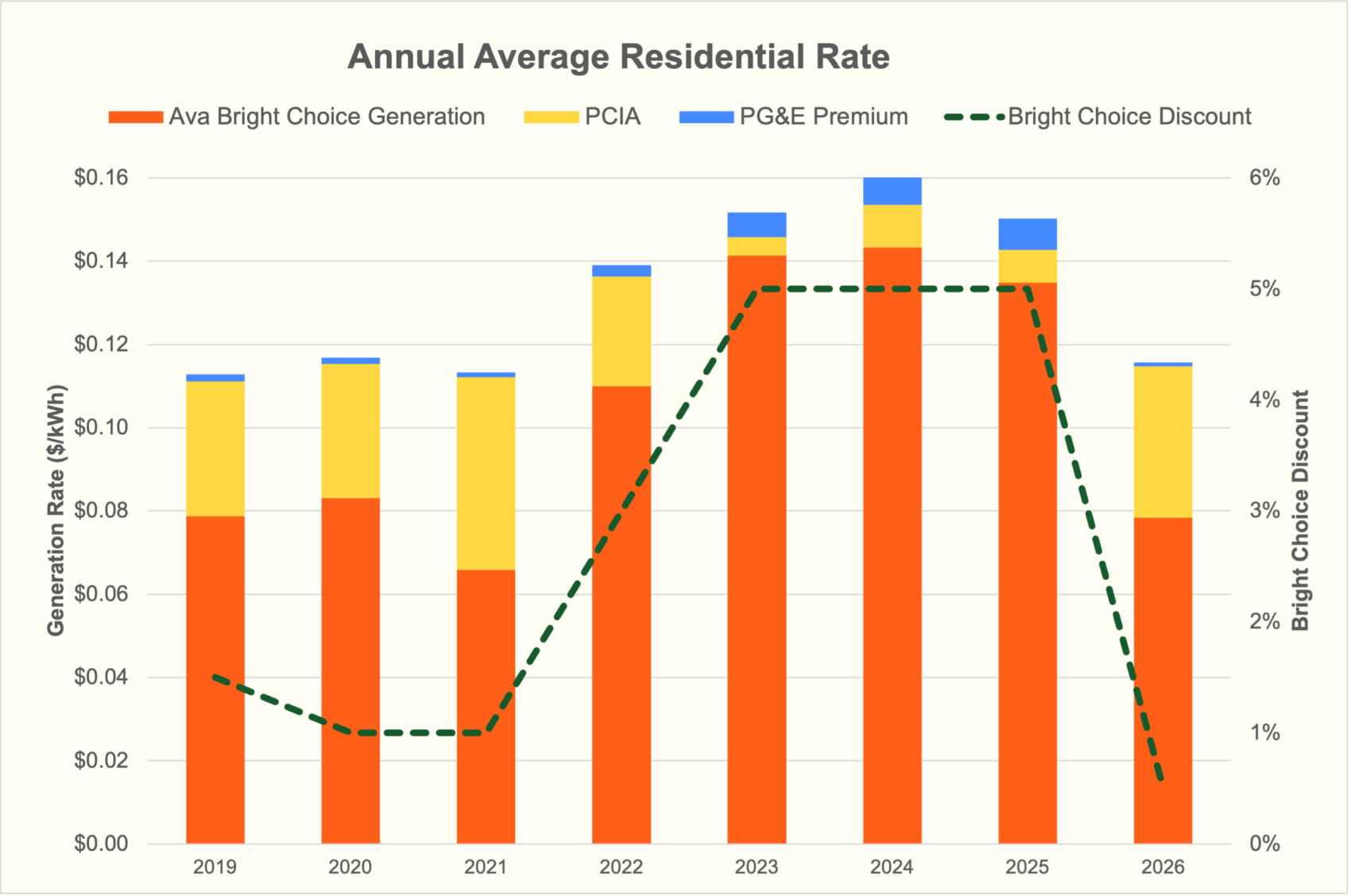
In all, generation costs for Ava customers are dropping 14% to 20% this year compared to 2025, depending on the rate plan, as shown in the figure below. The rate customers pay for Ava service is reflected by the orange (generation) and yellow (PCIA) bars together.
Delivery Costs Continue To Rise
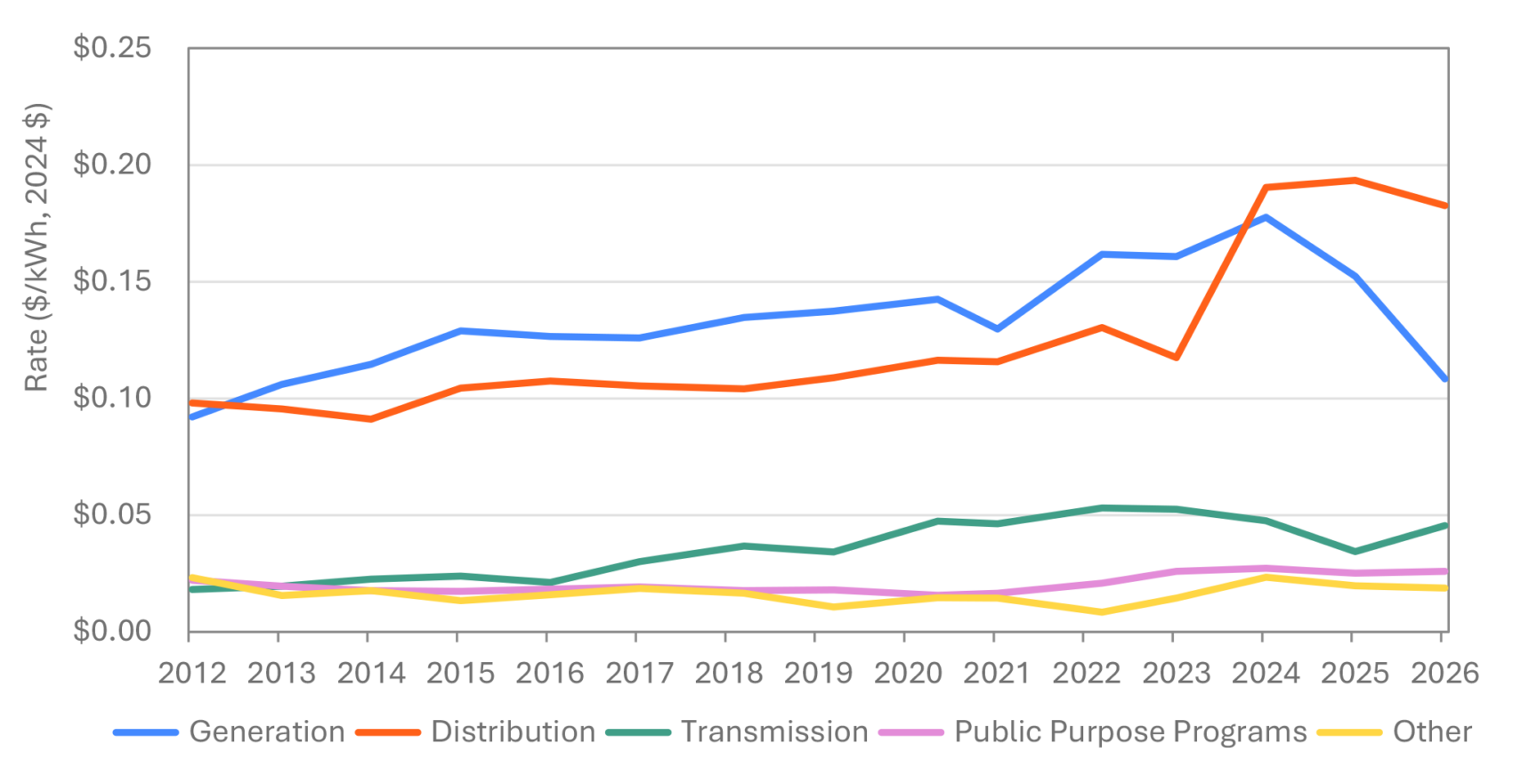
PG&E’s portion of the bill, for delivery costs, has risen steeply over the past several years. PG&E spending on the distribution system (the lower-voltage wires that connect homes and businesses) has risen by $2 billion a year, with almost half of the total cost driven by wildfire prevention. These costs have started showing up in rates, driving bills to unprecedented levels. As shown in the graph below, residential distribution rates (the orange line) jumped in 2023-2024 and have remained elevated. Total electric bill increases would have been even higher if it weren’t for a sharp drop in generation costs starting in 2025.
Bundled Residential Non-CARE Electricity Rate Components
To date, PG&E has put 1,200 miles of power lines underground, installed hundreds of weather stations and cameras to monitor local conditions, and inspected over 100,000 miles of lines to check for risk from vegetation, resulting in pruning or cutting down more than one million trees each year that are too close to a power line. PG&E has greatly reduced the number of Public Safety Power Shutoff (PSPS) events, shifting to more targeted “fast trip” shut-downs from Enhanced Powerline Safety Settings (EPSS). This equipment, installed on over 25,000 miles of distribution lines, detects faults and automatically shuts down local circuits.
PG&E’s work on the grid is nowhere near done. In July 2021, PG&E announced a multi-year effort to put 10,000 miles of lines underground. With reported costs of over $3 million per mile, full achievement of that goal could cost $30 billion.
In its 2023-25 Base Wildfire Mitigation Plan, PG&E laid out a budget of $18 billion, up from $14 billion over the previous three years. Its 2026-2028 Plan calls for spending another $18.6 billion on grid safety, with two-thirds of that going to undergrounding.
While operational costs like vegetation management are passed on to ratepayers every year, capital investments like undergrounding persist over the useful life of the infrastructure. As a result, they will impact rates for decades.
A Changing PCIA Landscape
The PCIA, or “exit fee,” is seeing a significant jump in 2026 due to both market conditions and CPUC decisions.
On the market side, falling generation costs for “brown power”—non-renewable energy such as gas—actually drive up the cost of the PCIA. Low market prices mean that when PG&E sells off the surplus power from old contracts, the sales lose money, and the PCIA makes up for the loss. That is charged to Ava customers.
But the PCIA is also rising due to recent regulatory changes to the Energy Resource Recovery Account (ERRA), the process by which utility expenses are settled each year. The CPUC has proposed to increase the PCIA rate for some CCA customers by 350-455% from 2025 to 2026, in some cases nearly ten times the increase faced by customers who get both generation and delivery from the investor-owned utilities.
A higher PCIA also cuts into the discount that many CCA customers receive relative to the PG&E generation rate, eliminating additional meaningful bill savings that could have been realized under a more balanced PCIA landscape. Customers on Ava’s Bright Choice plan are still paying a lower rate, but the discount was reduced to 0.5% from 5% last year. Similarly, Renewable 100 customers are now paying 1.75¢ more than the PG&E rate, up from 0.25¢ last year.
CalCCA, the state trade association of CCAs, has requested a rehearing of the decision, challenging what they call legal flaws in the CPUC’s decisions. “California law is clear: retail electric choice should not be used as a mechanism to shift costs from one group of customers to another,” said CalCCA CEO Beth Vaughan. “Unfortunately, the CPUC’s recent actions do exactly that, undermining the legal protections that exist to ensure a level playing field.”
In the California legislature, CalCCA is sponsoring a bill introduced by Assemblymember Chris Rogers that would implement new transparency measures for how the PCIA is calculated. Currently, the CPUC sets the rules and methodology for the PCIA, and each IOU updates its PCIA annually through the ERRA proceeding. But the data used to establish the charge is rarely made available to CCAs, severely limiting their ability to adequately plan for PCIA impacts and ensure customers are not being overcharged. AB 1761 would fix this by requiring the CPUC to share that data with all impacted load-serving entities.
Now Entering: The Base Services Charge
As if these plot twists weren’t enough, PG&E implemented a new fixed monthly charge starting in March. The new fee, known as the Base Services Charge, is $24 for most customers, but comes with a slight reduction in the per kilowatt-hour rate customers pay PG&E to deliver electricity. In other words, the Base Services Charge represents a change in how costs are recovered from customers, rather than an increase in the total magnitude of charges.
The charge comes from a legislative directive to adopt an “income graduated fixed charge” based on household income that is designed to shift the fixed costs of maintaining the electric grid away from charges that depend on the amount of electricity customers use. With the fixed charge, households that use a lot of power will pay less than before, but lower usage customers will pay more. Fixed charges for customers enrolled in the California Alternate Rates for Energy (CARE) or Family Electric Rate Assistance (FERA) program, or living in affordable housing, will be $6 or $12 a month.
Previous analysis by Ava staff found that Ava’s coastal customers will likely pay more, due to their relatively low energy consumption. This has the potential to wipe out the small savings from lower per-kWh costs.
The opposite is likely true for higher energy users, such as customers in the Central Valley who rely on air conditioning in the summer. The cities of Stockton and Lathrop joined Ava service after the Ava analysis was completed, so it’s possible that many customers in these areas will see their bills fall as a result of the Base Services Charge. Stockton and Lathrop also have the highest rate of customers on CARE and FERA, meaning their fixed charges will be lower. Households that convert their appliances and cars to electricity will have greater power demand (and less spending on fossil fuels), reducing the impact of the fixed charge.
Impact on Ava Customers
After all of these changes, the net impact for Ava customers is that overall rates are going to be slightly lower in 2026 than they have been for the last few years, though the new Base Services Charge could increase bills for many.
Overall, Ava’s residential customer generation costs are projected to decrease in 2026 by around $8 to $10 per month compared to 2025 levels. Generation charges for Bright Choice customers will fall by 20% from last year, while customers on Renewable 100 will see a 14% drop. These cuts will help counteract rising delivery and PCIA costs.
Read more about how PG&E rate changes affect your bill.