
Induction vs. Standard Electric Cooktops: What’s the Difference?
Induction Cooktop vs. Electric Resistance Cooktop
Choosing the right cooktop for your home kitchen is more than just aesthetics. It plays a role in safety, cookware requirements, how quickly meals come together, and how much energy your home uses over time. If you’re considering electric resistance or induction, you’re already on the right track. Both induction and electric resistance cooktops cut down the indoor air quality concerns that come with gas cooking, and reduce your carbon footprint. Induction cooktops have the added benefit of extremely efficient energy use.
In this guide, we’ll break down how each type works, compare performance and safety, and help you decide which option makes the most sense for your cooking habits, budget, and energy goals.

How is an Induction Cooktop Different Than an Electric Resistance Cooktop?
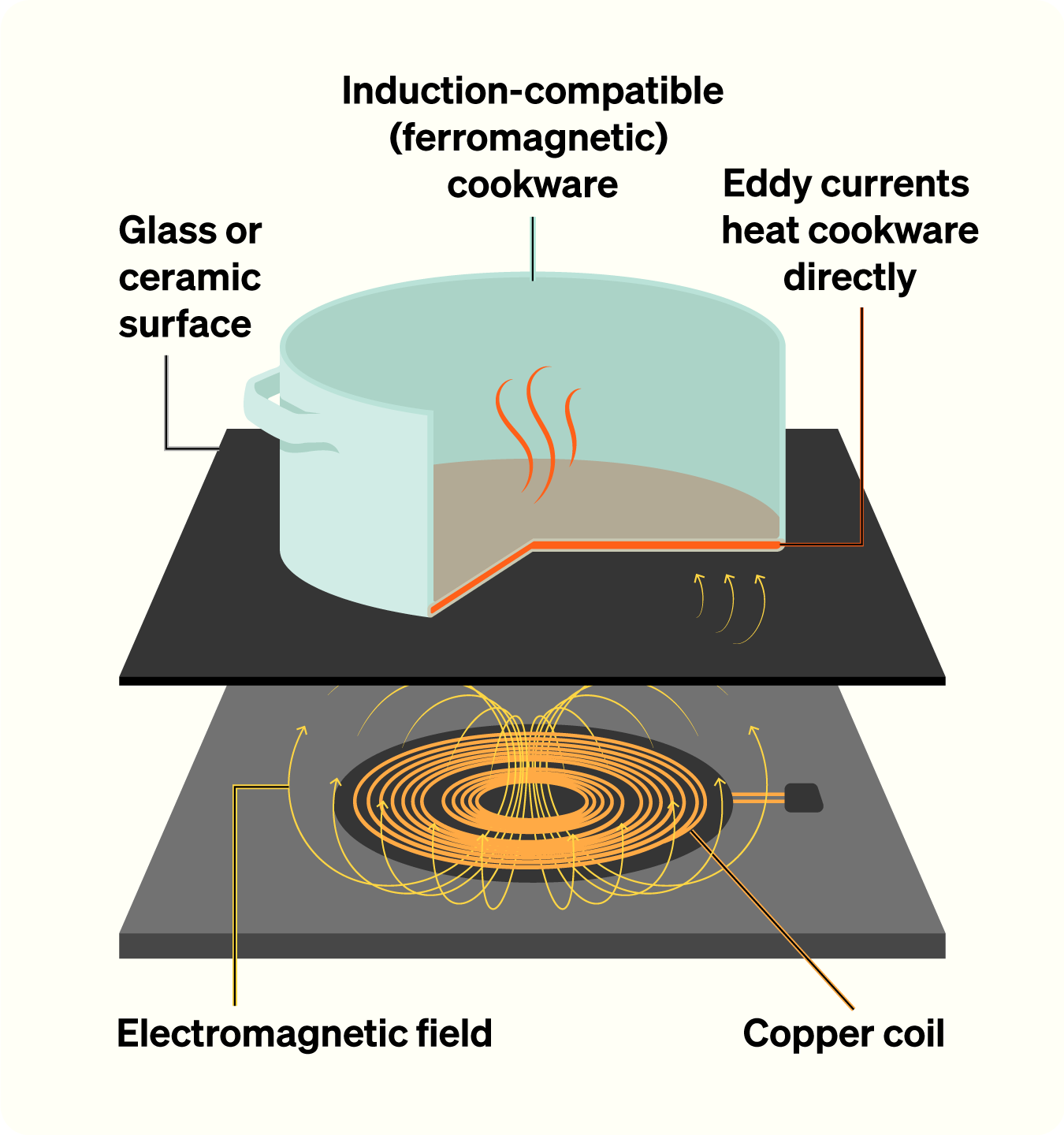
Both induction and electric resistance cooktops run on electricity, but they use very different technologies. The key difference is how the heat is created and delivered to your food.
- Electric resistance cooktops generate heat using heating elements either inside a coil or beneath a glass cooking surface. Once these elements warm up, heat radiates upward into the cookware and eventually into the food inside.
- Induction cooktops use electromagnetic energy to heat the cookware directly. Because the heat is generated inside the pot or pan itself (rather than under the cooktop surface), induction cooking is typically faster, more precise, and more energy-efficient. You can boil water in half the time!
This technological difference shows up in different costs, efficiency, and usage.
| Feature | Electric Resistance | Induction |
|---|---|---|
| Cost | Lower up front | Higher up front |
| Energy efficiency | 74% of heat is transferred to food | 90% of heat is transferred to food |
| Speed | Can take longer than a gas stove to boil water | Can boil 2x times faster than electric resistance |
| Temperature control | Imprecise and slow | Precise and fast |
| Cookware compatibility | Compatible with all cookware | Requires magnetic cookware |
What is an Electric Resistance Cooktop?
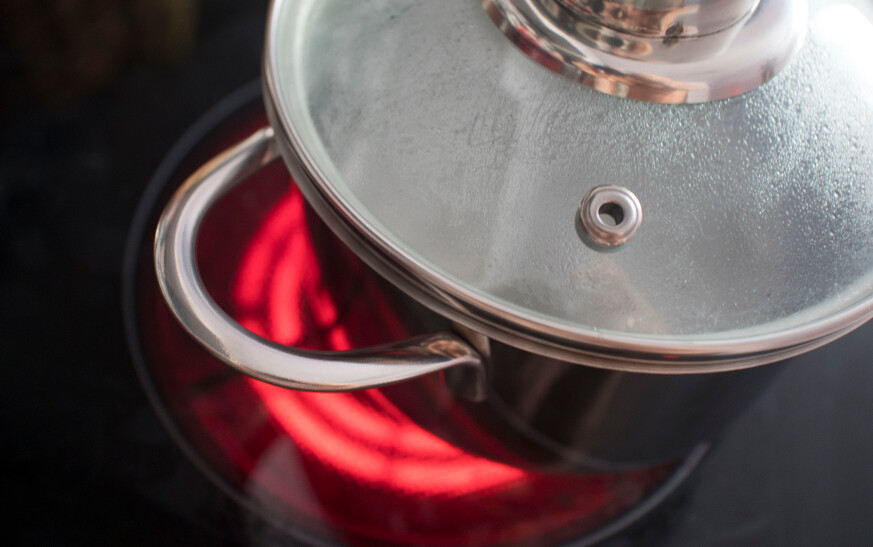
Electric resistance cooktops are some of the most common cooking surfaces found in homes today. This is a familiar option that has been around for decades and is often the “default” cooktop due to its simplicity and affordability. It’s the old standby.
Electric resistance cooktops pass electricity through resistance heating elements located either inside a coil or beneath a smooth glass surface. When turned on, the generated heat is transferred to the cookware. Ta‑da: the cookware then heats the food inside.
Because heat must travel from the coil or glass to the cookware, electric resistance cooktops tend to heat up and cool down slowly.
Pros of electric resistance cooktops
- Often more affordable than induction upfront
- Familiar technology that’s widely available
- Compatible with all types of cookware
Cons of electric resistance cooktops
- Takes longer to heat up and cool down compared to induction
- Temperature adjustments are not immediate or precise
- The surface stays hot after cooking, which can make it more difficult to clean and can be a safety concern
- Uses more energy than induction due to heat loss
What is an Induction Cooktop?
Induction cooktops use electromagnetic technology to heat. While they also use electricity, they don’t heat the cooktop surface in the traditional sense. Instead, induction cooktops directly heat the cookware. This means very little heat is lost between the cooktop surface and your food—making it quite energy efficient.
How Induction Works

An induction cooktop has some clever tech going on inside. Copper electromagnetic coils create a magnetic field that heats pots and pans directly. This means the cookware gets hot, but not the cooktop itself. The result is faster cook times, more precision, and a surface that stays surprisingly cool to the touch afterward.
There’s one small catch: induction cooking requires magnetic cookware. Cast iron and stainless steel work great, but aluminum or copper cookware will only work if it has a magnetic base. The cooktop won’t activate without magnetic cookware in place, and most models include lockable controls — helpful features when you have curious kids or pets around.
Can’t bear to part with your favorite pot or pan? You can get an induction adapter disk for less than $20 to ensure you can still use all your cookware on an induction cooktop.
From an energy-saving perspective, induction cooktops have a clear advantage. Because they heat faster and transfer energy directly into cookware, less heat is lost to the surrounding air. With induction, up to 90% of the heat generated is transferred directly to the cookware (versus 74% with electric). This efficiency can result in lower electricity use, especially for households that cook frequently.
Pros of induction cooktops
- Heat up extremely quickly, helping meals come together faster
- Offer precise, responsive temperature control
- Use energy more efficiently by directing heat straight into cookware
- The surface stays cooler, making them a safer option for families
- Easier to clean because food doesn’t burn onto the cooktop surface
Cons of induction cooktops
- Typically have a higher upfront cost
- Require magnetic cookware, which may mean replacing some pots and pans
- Can take a little time to get used to for first-time users
Which is Better for Your Home?
Bottom line: induction offers the most control and energy efficiency, but any electric cooktop is superior to a gas stove. The choice comes down to your budget, cooking style, and household needs.
Choose electric resistance if you’re looking for:
- A lower initial investment
- Simple, familiar cooking technology
- Flexibility to use any cookware
- Basic, everyday cooking needs
Choose induction if you’re looking for:
- Faster cooking and higher-performance results
- Greater energy efficiency
- Added safety for households with children or pets
- More precision and control while cooking

Common Misconceptions
At first glance, electric resistance and induction cooktops can look nearly identical, which is why they’re so often confused. But beneath the glass surface, they work in completely different ways. Before you decide which one belongs in your kitchen, let’s clear up a few of the most common misconceptions.
“Induction is just a fancier electric resistance cooktop.”
Sure, it’s state-of-the-art and uses electricity, but induction is actually a completely different technology from an electric resistance cooktop. It’s faster, more precise, and uses energy more efficiently.
“Electric resistance and induction cooktops heat the same way.”
Both run on electricity, but that’s where the similarities end. Induction uses magnetic energy to direct heat straight into the cookware, which means food heats up way faster and more precisely than a traditional electric cooktop.
“Induction cooktops get just as hot as electric resistance.”
With induction, the cookware heats up, not the cooktop surface itself. One of the advantages of an induction cooktop is how surprisingly cool the surface is after use.
“Induction requires special outlets.”
Many induction models use the same 240-volt power supply as electric resistance ranges, so if you’re replacing an electric range with induction, you probably won’t need to make any upgrades. But if you live in an older home and are switching from gas to induction, you may need to look into a panel upgrade.
“Food cooked with gas is better than food cooked with electricity.”
There’s no evidence that food cooked with gas tastes better. What does affect food quality is precise temperature control, and induction outperforms gas in that area. Plus, unlike gas, induction doesn’t emit nitrogen dioxide, a pollutant linked to higher risks of asthma and heart and lung diseases.
Final Takeaway
Induction offers the most control and energy efficiency, but both induction and electric resistance cooktops are safe, modern, and an enormous upgrade over gas stoves. The best pick is the one that fits your budget, cooking style, and priorities like responsiveness, ease of cleaning, and energy use.
If you’re considering an upgrade, consult a qualified installer or electrician so you end up with the option that works best for your household.
Make the Switch
Ready to ditch the gas range and upgrade your kitchen? Ava is here to help. Use our handy incentive finder to see if you qualify for any savings or rebates on induction or other energy efficiency upgrades.