Public Charging Etiquette: 5 Tips for EV Drivers
If you drive a gas car, you know it’s easy to find a gas station by looking for a big colorful sign in the sky. Once there, you know exactly where to join the line, how to fill up, and follow other unspoken etiquette rules so everyone can quickly fill up and get on with their day. For electric vehicle (EV) drivers, the unspoken rules for using public charging stations are a little different.
First, Know What Chargers Your Vehicle Supports
Unlike with gas cars, EV drivers need to know what charging standard their vehicle uses and if it’s supported at the charging station.
Let’s review the terminology of charging equipment:
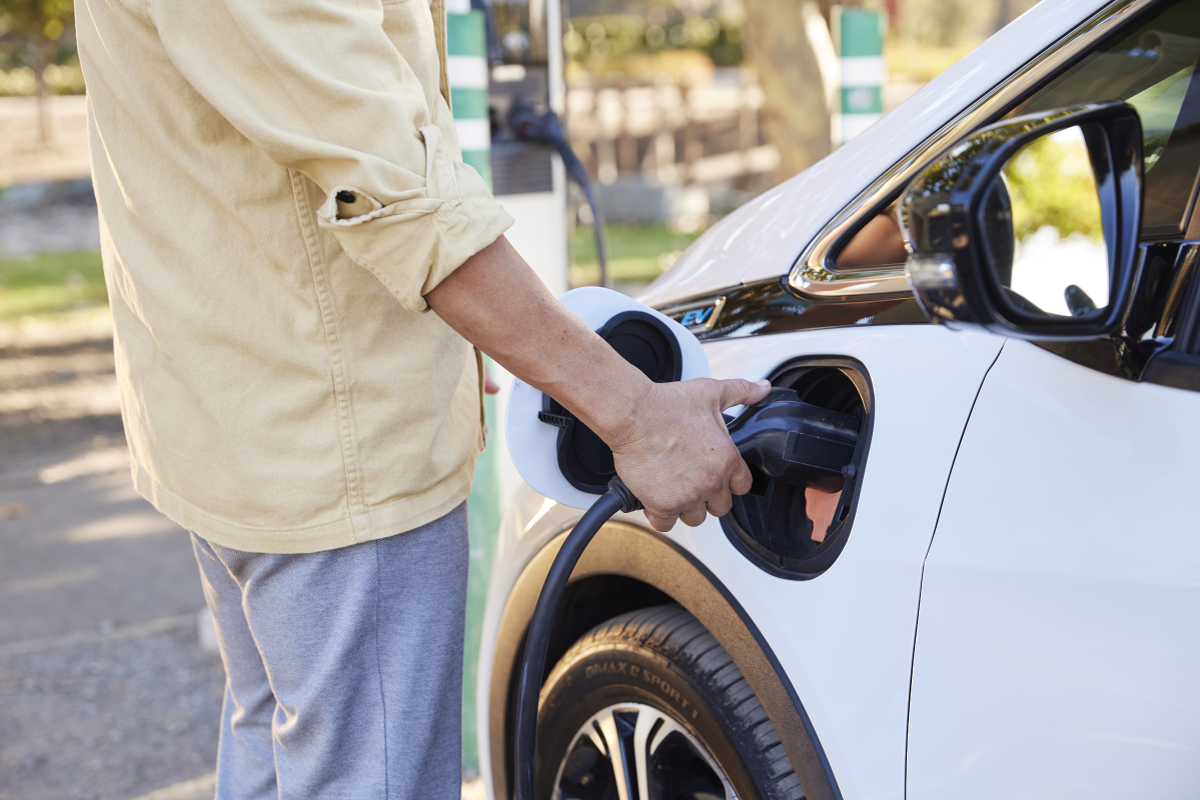
- The plug is the physical piece at the end of the charging cable. The plug is attached to the charging station (for public chargers) or your home charging cable.
- The connector (sometimes used interchangeably with “plug” in casual EV language) is the plug’s “type” or “standard,” just as USB-C is a standard for computer equipment.
- The port is the socket on the car where the plug goes. This is similar to the port on your phone into which you insert the charging cable, like the USB-C port. The connector type must match the port type.
There are currently three common connector standards:

NACS
Originally developed by Tesla and now being adopted as standard in 2025 model cars from the major automakers. This is the default standard at Tesla Superchargers.

CHAdeMO
DC fast-charging connector used mostly by older Nissan Leafs and now being phased out. Ava Charge, EVgo, and ChargePoint currently have CHAdeMO chargers available in Oakland and Berkeley.

CCS
The default connector standard used by most vehicle manufacturers, with the notable exception of Tesla. Starting in 2025, most major auto manufacturers started their transition from CCS to the NACS port.
While the newest EVs with NACS can charge at Tesla Superchargers without adapters, Tesla drivers can charge at non-Superchargers as long as they have a CCS adapter or if the station has NACS connectors.
Tips for EV Drivers
1. Wait in a Conspicuous Area but Don’t Block Others
Charging stations don’t have built-in queuing lanes like gas stations. If all chargers are occupied, park in a regular parking spot near the chargers or along the edge of the charging area. Don’t block the exit path. It’s often easy to spot who’s waiting ahead of you, especially if the driver is waiting in their EV. It’s also polite to ask if they’re in line.
It’s often easier to figure out where the queue is at larger charging sites, like at Tesla Supercharger stations. If you see an obvious queue, join the back and wait in your car.
2. Know How To Park for Charging
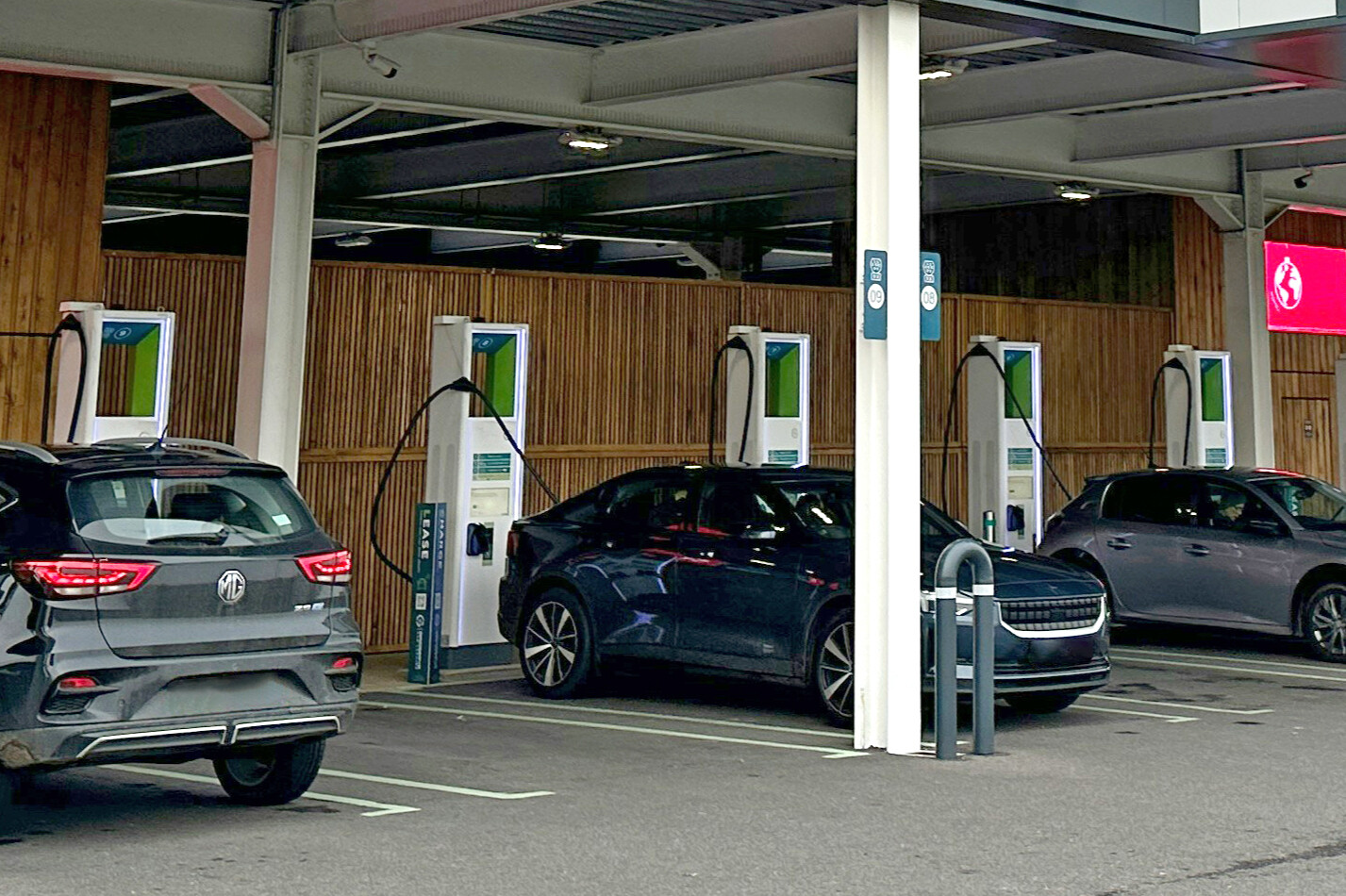
Since there is no standard for where charging ports are located on EVs, DC fast-charging cables and stalls come in many configurations to best meet the needs of different vehicles. Many EVs have rear-mounted charging ports, so pull in by backing into the bay. If your port is at the front of the car, pull in head-first.
If you’re charging at a stall that has two chargers, and the second charger is being used by another vehicle, it’s worth knowing that it generally takes longer for both vehicles to charge. This is because the stall is splitting the power between the two vehicles. Out of courtesy to the other driver, charge at an empty stall if one is available, so you’re not slowing down the charge for you or your neighbor.
3. Keep An Eye On When Charging Is Complete
It typically takes about 20 minutes at a DC fast-charging station to charge an EV battery from 10% to 80%. Your vehicle should show you the estimated amount of time it will take to charge, so check that before heading out to stretch your legs or grab a coffee. Set up an alert to let you know when the charge is almost done. Some charging stations may charge an idle fee if vehicles are left in the stall after a charge is complete.
4. Be Mindful of Your Car’s Charging Rate
In general, smaller cars accept less energy than larger cars when charging. This could make smaller cars a bottleneck at DC fast charging stations when larger vehicles are waiting.
For example, the Chevy Bolt has a maximum charging rate of around 55 kW. If the Bolt charges at a DC fast charger that offers up to 350 kW of charge, the vehicle would still only be able to accept up to 55 kW. The rest of the power goes unused. Compare this to the Porsche Taycan, which reportedly charges at an average 213 kW on a DC fast charger.
If you know that your vehicle accepts a charge at slower rates, consider avoiding fast charging stations during busy times and instead charge at Level 2 stations. These can be found onsite at local retail centers, school campuses, or community centers.
Additionally, EV battery charging rates significantly slow down as they approach and exceed 80% — sometimes doubling or more the time it takes to charge from 10% to 80%. Unless you’re on a road trip and will immediately use the extra mileage, it’s generally best for your battery (and for those waiting to charge) to cap your charging at 80% to make sure the next person can plug in.
5. Try To Use Your Car’s Default Charging Standard
While the industry moves to standardize on the Tesla NACS/J3400 connector standard (similar to how device manufacturers are moving to the USB-C standard), vehicles before 2025 use one of three standards (see the callout box below). With the exception of older Nissan Leaf models, most vehicles can use other standards with the use of adapters. However, at busy charging stations, it’s best to stick with the default standard for your car so drivers without an adapter can charge using their default charger.
Bonus Tips: Charging at Superchargers for Tesla and Non-Tesla Drivers
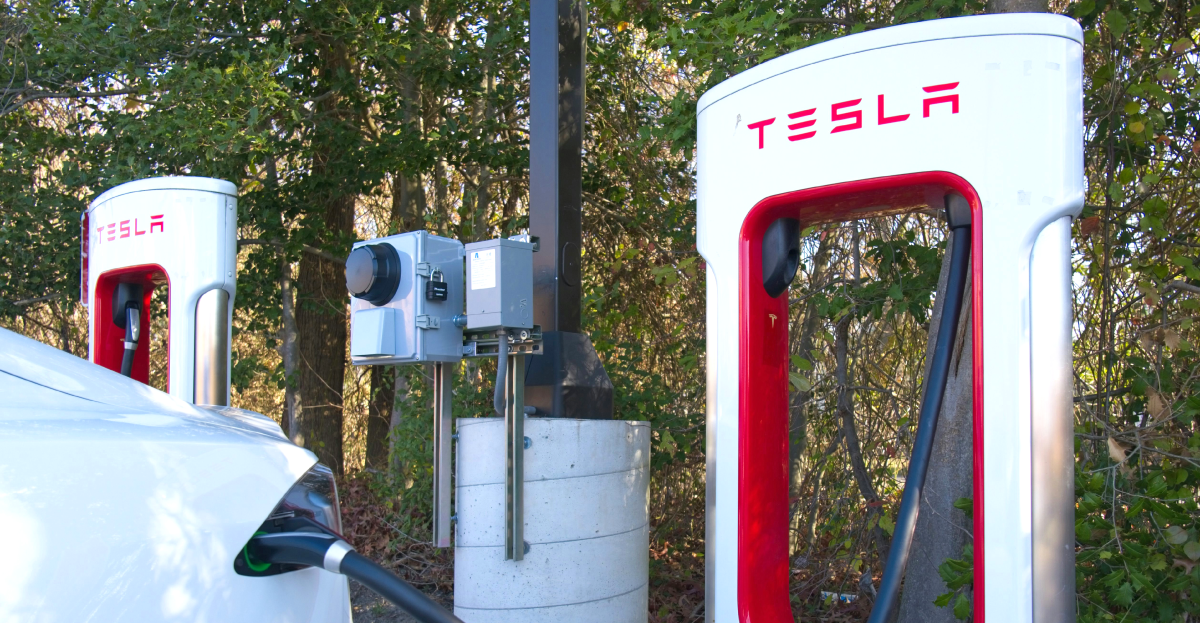
Some EV manufacturers began shipping 2025 models with ports that support the Tesla NACS/J3400 connector standard. This means that newer EVs can charge at participating Tesla Superchargers. Expect more and more non-Tesla EV manufacturers to produce cars with the Tesla NACS/J3400 charging port as the industry moves to standardize.
Non-Tesla drivers must purchase a NACS adapter to charge at Tesla Superchargers. Currently, not all Superchargers support non-Tesla vehicles. To find a Supercharger available for non-Teslas, search on the map on Tesla’s website, or the PlugShare app.
While Tesla doesn’t publish an official count of Superchargers, there were thought to be 2,128 in the US as of January 2024, with the largest percentage (20%) found in California, according to independent sources.
Here are some quick tips for all drivers using Superchargers:
Locating a Supercharger:
Find the nearest Supercharger by downloading the Tesla app and creating a profile (non-Tesla users can still download the Tesla app), or by using the built-in app in your vehicle. You can also use PlugShare or Google Maps to locate nearby Superchargers. Check that the Supercharger will support non-Tesla vehicles using the NACS adapter.
Paying for a charge:
You can pay through the Tesla app. Some Superchargers will also let you pay at the charger, just like at a gas station.
Move your vehicle promptly after charging:
Tesla may charge an “idle fee” or a congestion fee if your car isn’t moved promptly after a charge. An idle fee is charged for every minute a vehicle is connected to the charger after a charge is complete, though it does give a 5-minute grace period.
A congestion fee is charged at busy sites and when a vehicle’s battery is already at or above 80% charged. Tesla says the fee is designed to encourage drivers to charge only as much as is needed for their trip because charging from 80% to 100% is designed to be slower to avoid battery damage. Please check Tesla’s website to learn more about these fees and to understand the current rules.
Parking to charge:
The charging cables at Superchargers were originally designed for Tesla’s rear-mounted charging ports and for Tesla drivers to back into the bays. Parking a non-Tesla with front-mounted ports may be tricky at busy times.
If your charge port is at the front of the car, you’ll need to pull in head-first. This may mean parking over the dividing line for the cable to reach the port if it is on the front driver side of your vehicle. Drivers of larger vehicles may need to park horizontally across several bays. If either is the case, it’s best to charge at less busy times or at another fast charging station that isn’t a Supercharger.
If you drive a Tesla, and you have a choice of stalls to back into, try to use one of the center bays and leave the outer ones for non-Tesla cars to fit in more easily. Additionally, spacing out from other cars actively charging should generally enable the best power sharing to get everyone the fastest charge the site can offer.
Looking forward: Tesla is rolling out high-power V4 Superchargers with cables that will reach all EVs within the same stall. Little details exist about where these might be located in California, but eagle-eyed watchers reported one of the first planned in Campbell.
Learn more about charging non-Tesla EVs on the Tesla site.
Driving an EV should be a pleasant experience—and charging at public stations can be relaxing. While your car is charging, you can catch up on emails, grab a cup of coffee, or play games. Be sure to keep these 5 unspoken rules in mind to ensure you and others continue to enjoy your EVs to the fullest.