
How PG&E Rate Changes Impact Ava Customers
Last updated: January 2026
It’s no secret that electricity costs in California are high. If you’ve been concerned about rising energy bills for the past few years, you’re probably wondering what to expect in the new year.
Here’s what you need to know about PG&E rate changes, how they affect Ava customers, and what you can do to manage your energy costs.

Understanding Your Bill: Ava Charges vs. PG&E Charges
PG&E energy bills have three main components: electric generation, electric delivery, and gas charges.
Electric generation (producing energy): This is what Ava provides. We generate clean electricity and pass it along at stable, competitive rates. This typically accounts for 25% to 45% of your total electricity bill. Ava sets these rates.
Electric delivery (getting power to you): PG&E owns and maintains the transmission lines, distribution systems, and meters. They deliver the electricity that Ava generates, and also handle billing. PG&E sets these rates.
As an Ava customer, you’ll see generation and delivery as separate line items—but Ava is not an additional charge. We’ve simply replaced PG&E as your generation provider, which means you’re getting all the benefits of community choice energy.
If you’re not an Ava customer, PG&E bundles generation and delivery together as one charge on your bill.
Gas charges: PG&E, or a third party you contract with, supplies natural gas to your home. Ava does not provide gas service, so these charges are unrelated to Ava or electricity.
For a deeper dive into the components of your PG&E bill, check out our Understanding Your Bill explainer.
What’s Changing on Your Electricity Bill in 2026
January 2026: Lower generation rates, higher delivery rates
To begin the year, Ava lowered rates for the service we provide (electricity generation) by about 20% for Bright Choice customers and about 15% for Renewable 100 customers. Learn more about how Ava sets generation rates.
At the same time, PG&E increased its transmission and distribution rates, and is planning additional rate changes in March and September 2026. Ava’s rate decrease helps offset these increases.
Although Ava doesn’t provide gas service, it’s worthwhile to note that PG&E’s gas rates also decreased by 6.7% from December to January.
March 2026: PG&E is implementing the Base Services Charge
Starting in March, PG&E will be restructuring the transmission and distribution portion of the bill to include a separate line item for infrastructure and maintenance, known as the Base Services Charge.
According to PG&E, this is not a new fee—these costs were already included in PG&E’s delivery charges. However, the new structure may increase or decrease your monthly bill depending on how much electricity you use. Higher usage customers may pay less overall, but lower usage customers may pay slightly more.
PG&E Rate Increases Over Time
California currently has among the highest electricity rates in the U.S., not only growing faster than inflation but also outpacing increases in other states. According to the Public Advocates Office of the California Public Utilities Commission, average residential electricity rates increased 104% between January 2015 and April 2025. The average combined gas and electric bill has risen from about $179 in 2020 to around $300 today, with the biggest change happening in 2024.
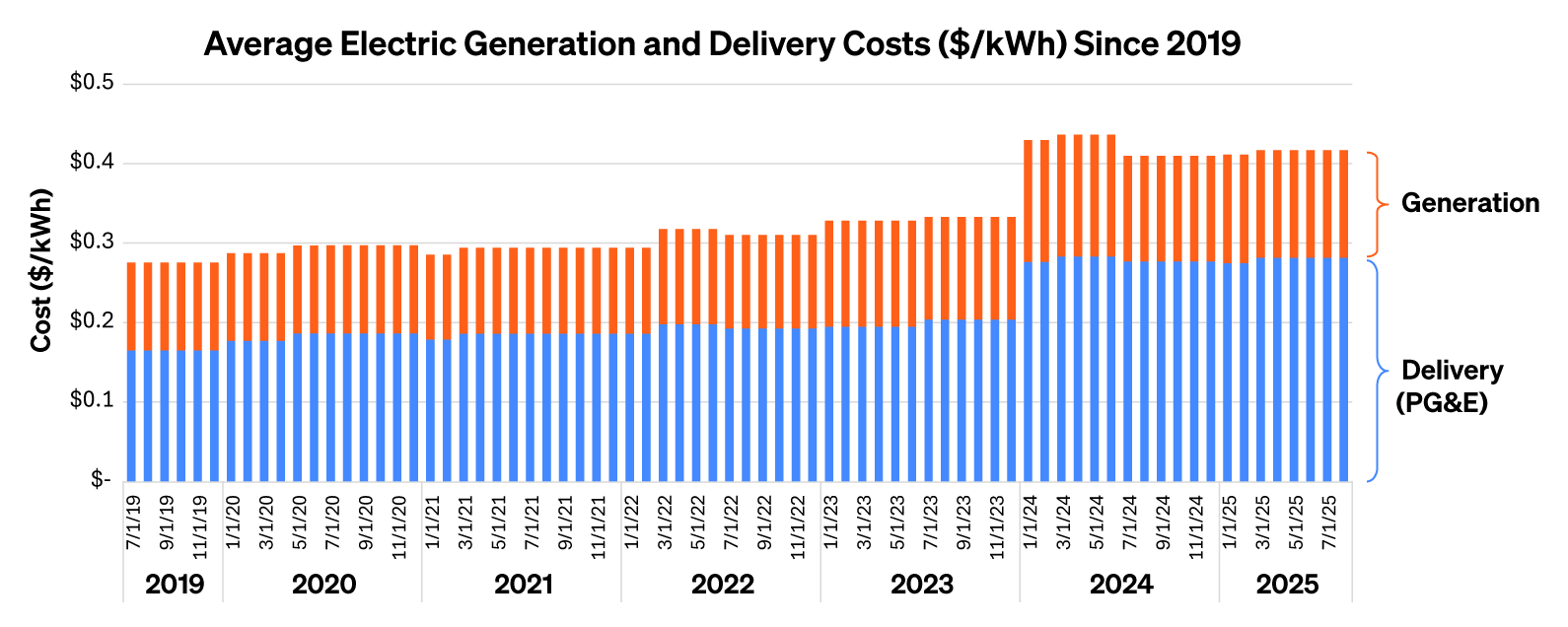
Electricity generation and delivery costs since 2019, with a notable increase in delivery costs shown in 2024.
The biggest increases have happened in the delivery (transmission and distribution) part of energy bills, which PG&E controls. In general, delivery accounts for the majority of residential electricity costs.
According to PG&E and the California Public Utilities Commission (CPUC), several major factors have pushed delivery rates higher:
- Wildfire mitigation: PG&E has spent billions on equipment upgrades, vegetation management, and grid hardening following devastating wildfires. These safety measures are expensive: wildfire-related spending has made up roughly 18% of PG&E’s overall system costs.
- Transmission and delivery infrastructure updates: Much of California’s electrical grid was built decades ago and requires lots of maintenance and replacement to meet modern reliability standards.
- Regulatory compliance: PG&E cites state mandates for renewable energy, grid reliability, and safety standards as adding operational costs.
- Shareholder returns: Unlike Ava, PG&E is a for-profit investor-owned utility, which means some of PG&E’s revenue goes to shareholders. It’s less than 1% of your combined gas and electric bill.
Other Reasons for Higher Bills
The time of year, time of day, and how much energy you use can also impact energy bills.
For customers on a time-of-use (TOU), electric vehicle (EV), or E-ELEC rate with PG&E, the four months of summer (June through September) have higher rates than October through May. So you may notice your bill jump up in June or July compared to the previous months. If so, it’s a good idea to review and optimize your energy usage!
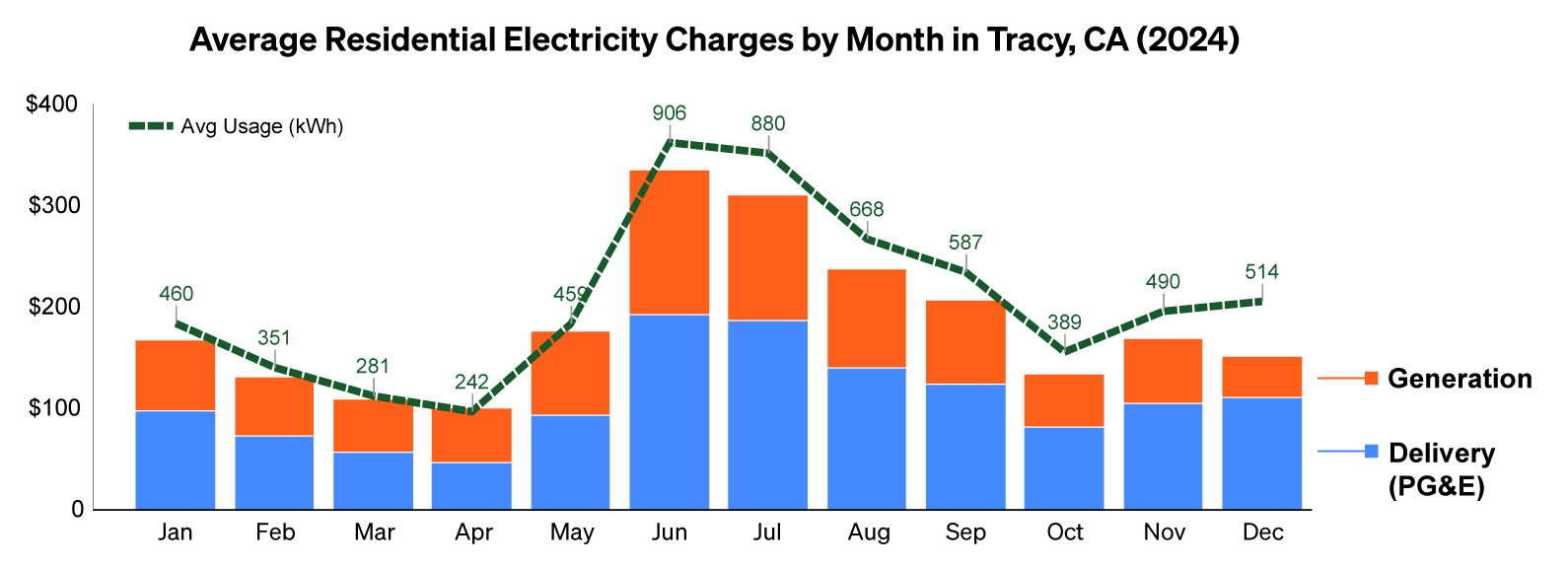
An example of seasonal rate changes as shown by average electricity charges for residential customers in Tracy, CA. Costs and kWh usage were nearly double in the summer months compared to winter.
Although rates are generally lower during the winter than the summer, households tend to use gas appliances like heaters more. Cold weather and increased heating costs can drive up bills during the winter months. Follow these tips from KQED to save energy and help lower your bill.
Why are Ava customers still impacted by PG&E rate increases?
Because Ava provides electricity generation and PG&E provides electricity delivery, delivery rate increases affect everyone in PG&E’s service area equally—whether you’re an Ava customer or not.
Ava customers can also choose PG&E to provide electricity generation service, and can always choose the service plan that best fits their priorities. In January 2026, Bright Choice is 0.5% lower than PG&E service, and Renewable 100 costs 1¾ cents more per kWh than PG&E.
The biggest difference is where that money goes: as a public agency, Ava doesn’t have shareholders or investors, so ratepayer money stays within the community.
What is Ava doing about affordability?
As a not-for-profit community energy provider, we’re working on multiple fronts to ensure the long-term well-being of our community. For us, that means every customer should be able to access affordable, clean power. Here’s how we’re building that future:
Long-term renewable energy sourcing
We’ve locked in stable, lower-cost renewable energy through multi-year contracts that protect you from market swings. We’re continuing to build new wind, solar, and battery projects to add more local clean energy to our grid.
Direct bill savings and credits
Ava customers have saved over $180 million on their electricity bills since 2018. In addition to providing lower rates and returning funds directly to our customers when possible, we’ve also invested in a rate stabilization fund to protect against future market volatility.
Local programs and community reinvestment
As a not-for-profit public agency, we have no shareholders and all our excess revenue gets reinvested in the communities we serve. We develop energy programs to save customers money while helping the environment, and provide grants and sponsorships to local organizations that help our communities shine.
Policy advocacy in Sacramento and Washington
Ava advocates at the state and federal levels for legislation that makes electricity more affordable, protects community choice, accelerates decarbonization, promotes local development, and increases bill transparency.
What can you do to manage your energy costs?
While PG&E rate changes will continue to happen, you have options to help reduce your usage and costs.
Immediate steps:
- Understand your PG&E rate plan. The most important first step is to review your rate schedule and make sure you’re on the best plan for your lifestyle and usage patterns.
- Avoid peak hours. Most Californians are on a time-of-use (TOU) rate, which means electricity costs more during peak hours (typically 4-9 p.m.). If possible, avoid using major appliances like laundry machines, heaters, or EV chargers during these times.
- Switch to Bright Choice. If cost is your top priority, Ava’s Bright Choice service plan is the cheapest option available. It’s currently 0.5% lower than PG&E’s generation rates.
- See if you qualify for CARE or FERA. These statewide programs provide monthly bill discounts to income-qualified customers, regardless of whether you’re an Ava customer or not.
Longer-term strategies:
- Consider energy efficiency upgrades. From small changes like weatherstripping and using LED lightbulbs to bigger upgrades like buying a heat pump heating/cooling system, every step counts. Get started with electrification here.
- Look for rebates and incentives. You may have heard that federal incentives for electrification are changing, but there’s still time—and local and state incentives aren’t going away. Check our Incentive Finder to find rebates, programs, and incentives that you qualify for based on your zip code and housing situation.
Looking ahead: Are future increases planned?
PG&E electricity rates are expected to stabilize through 2026 and 2027. The biggest upcoming change to your bill will be in March 2026, when PG&E implements the Base Services Charge. The financial impact on your bill will depend on your electricity usage, but most customers will see a slight increase.
The best defense against rising rates is understanding your usage, taking advantage of available programs and incentives, and increasing your energy efficiency where you can.
As your not-for-profit local energy provider, Ava is here to help navigate these challenges. We monitor rate changes closely, negotiate long-term contracts to provide stability, and work at the policy level to address the root causes of rate increases. Most importantly, we’re committed to being your trusted resource for understanding your energy options and connecting you with the right programs and assistance when you need them.