Ava Pilot Program Tests the Switch from Gas to Electric Cooking
August 13, 2026
Ava spent a year installing all-electric induction ranges in income-qualified households. Our new Health-e Communities Pilot report shows that while it yielded positive air quality results, it also revealed significant barriers to home electrification at scale.
Converting home appliances from gas to electric is a key part of the fight against climate change, cutting indoor and outdoor air pollution, and putting Ava’s clean electricity to work displacing fossil fuels. Eliminating gas-burning devices can also create safer, healthier homes.
But despite many state and local electrification incentives, making the switch is not always easy. High-efficiency electric appliances can cost more to install than their gas counterparts, especially if homes need to be rewired to accommodate them. And the delay caused by the rewiring can be an impediment, since a household may have to go without cooking, heat, or hot water while the work is being done.
Enter Ava’s Health-e Communities Pilot program, which installed new electric induction ranges at no-cost for income-qualified customers. In addition to reducing emissions and helping more households make the switch from gas appliances, the pilot aimed to test air quality impacts and identify critical barriers to deploying electrification programs. The pilot was open for one year and targeted 200 participants maximum, but the goal was to find out what it really takes, including the time and funding needed, to deliver the benefits of induction cooking at a larger scale.
As it turned out, there are many hurdles that program administrators, like Ava, have to clear to get these appliances into customer homes. These included lengthy permitting timelines that varied by local jurisdiction and issues with a home’s electrical wiring.
Despite these challenges, we found that completed projects resulted in meaningful air quality improvements and participants were overwhelmingly satisfied with their new induction range.
Program Design
Compared to furnaces and water heaters, gas ranges don’t use a lot of energy in most households, but they are the only gas appliance that does not vent its pollution outdoors. Combustion products like nitrogen dioxide and carbon monoxide are released into the kitchen, and only some kitchens are ventilated with fans or open windows.
Studies have shown that this indoor air pollution contributes to lung diseases like asthma and chronic obstructive pulmonary disease (COPD). For low-income households, which are more likely to be located near other pollution sources like freeways and factories, gas ranges can be an additional pollutant contributing to greater health risks.
Health-e Communities was set up to specifically target Ava customers living in these sensitive areas and track how replacing gas ranges with induction ranges impacts air quality within their homes. Over the course of one year, the $1.25 million pilot covered the full cost, including labor, for 162 installations, with an average direct installation cost of about $5,000 per project.
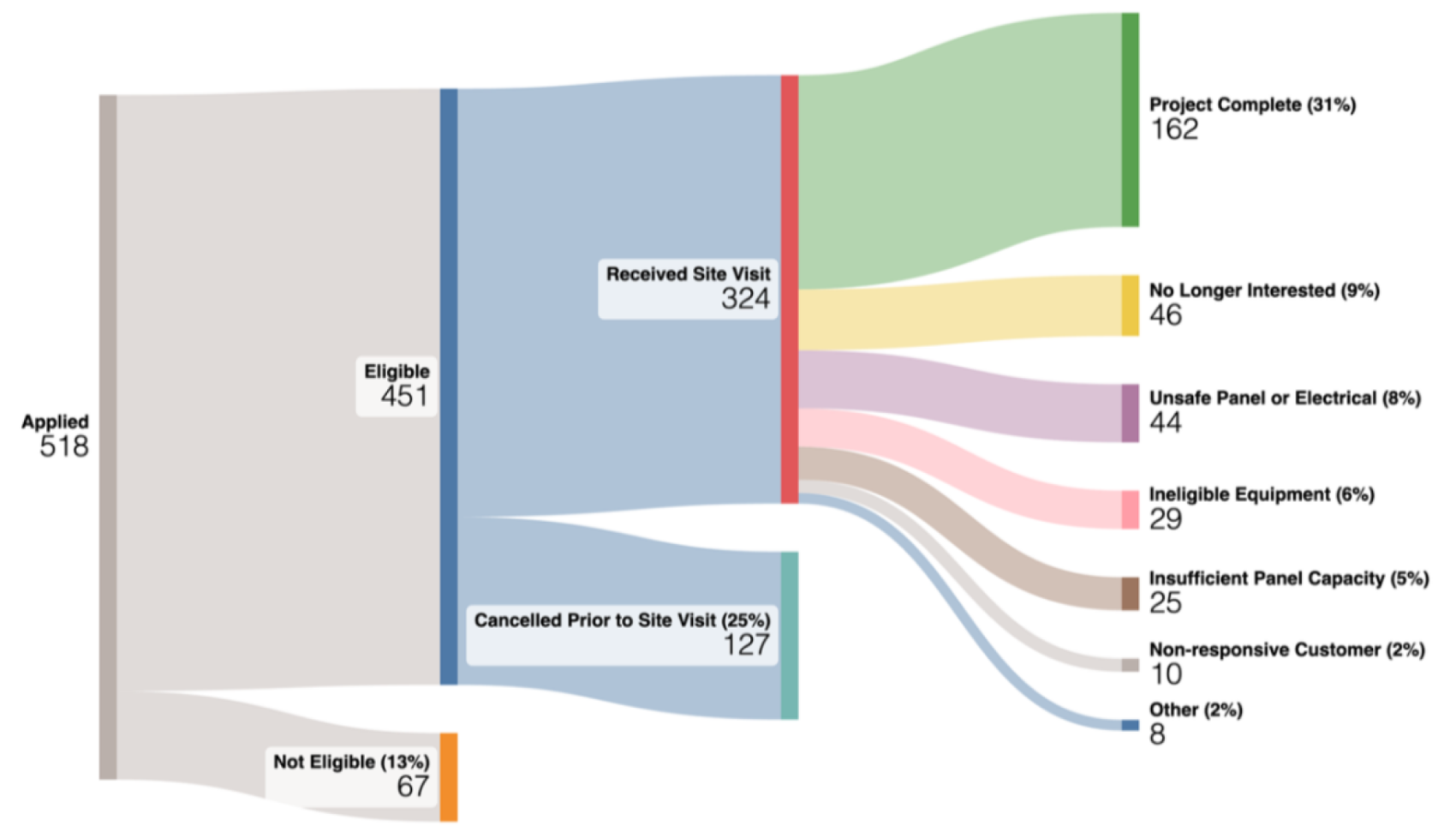
The program was offered to customers enrolled in the California Alternate Rates for Energy (CARE) or the Family Electric Rate Assistance (FERA) programs or who live in an affordable housing unit, with marketing campaigns focused in areas with the highest asthma rates, as identified by the state’s CalEnviroScreen 4.0 screening tool. Ava targeted approximately 56,000 eligible customers via email, resulting in a total of 451 eligible applicants (see diagram below for a detailed breakdown of total applications and final status). Given the Pilot’s limited budget, finite number of air quality monitors, and logistical complexity, broader outreach campaigns or additional marketing tactics would have likely overwhelmed the pilot and created significant backlogs.
To monitor air quality, Ava used a grant from the Energy Foundation to partner with the Berkeley Air Monitoring Group, which performed pollution testing in kitchens before and after each range was replaced.
While Ava led program design and handled participant recruitment and applications, we partnered with Franklin Energy Services to facilitate the installation work, serving as the main go-between for program participants and qualified third-party electrical contractors.
Health-e Communities Pilot Applications by Final Status
Permitting Challenges
Replacing an existing gas range with an electric induction range isn’t as simple as taking out the old and plugging in the new. Most installations require running a new dedicated electric circuit, capping the gas line, and completing the associated permits. And in some cases, additional measures may be necessary, like adding a tandem breaker or repairing drywall.
Installing an induction range generally requires running a 240-volt electrical circuit, an upgrade that requires a permit from most local authorities having jurisdiction (AHJs) — usually a city or county. This is an important step that ensures the work is checked for safety and quality.
Permits are mainly handled by installers, who for this program applied for the permits shortly after the initial site assessment was completed. Then, they wait for approval — which, in some cases, can take weeks.
For this program, installers applied for permits across 14 different AHJs, each with its own timeline, processes, and specifications. These local differences led to wait times that were highly varied, ranging from an average of one to 31 days. Some permits were approved same-day, while others took as long as 65 days. The pilot-wide average waiting period was approximately eight days.
Permitting added logistical complexity, costs, and increased project timelines, which averaged 90 days from pilot application to final install. The reasons behind wait times varied, from complex building code issues and back-and-forth communication between permit staff and installer, to simple permit office backlogs.
Dan Bertoldi, Ava’s Electrification Program Manager, sees opportunities for improvement. “Permitting is a necessary, yet often time-consuming, part of the electrification process,” he says. “Our experience indicates it could benefit from streamlining and standardization across our member jurisdictions. There is great opportunity here to improve electrification outcomes.”
While the Health-e Communities Pilot was limited to induction ranges, other appliances can also see installation timelines stretched by permitting delays, such as heat pump water heaters and HVAC systems. Solar permitting has already been addressed by AHJs with better online procedures, reinforced by state policy.
Fortunately, there are policy solutions that could help make the permitting process work better and faster for everyone involved. Ava is supporting SB 222, a bill from Senator Scott Wiener that aims to improve permitting and cut down on wait times for heat pump appliances, specifically. If applied to other home appliance upgrades, its requirements for cities and counties to offer asynchronous installation inspections and an automated permitting process could also help make permitting easier for induction ranges.
(Not So) Electric Ready
Another barrier was electrical problems in homes, especially substandard breaker panels and wiring.
In order to make the switch from gas to induction, a home has to have enough electrical capacity and properly working equipment to incorporate the new range. If there isn’t enough capacity, or if the breaker panel or wiring is unsafe, work would be needed to either repair or replace the existing electrical system, adding time and costs.
Induction ranges typically require 40 to 50 amps of electrical capacity in a circuit. While most panels can handle that, older and smaller ones may not be able to. Although the pilot did not support outright electrical panel replacements, it did cover workaround solutions to optimize existing infrastructure, like reorganizing circuits or installing sub-panels, tandem breakers, and circuit switches. Even then, not all prospective participants were able to move forward.
“We had to cancel a number of installations due to unsafe or recalled panels,” says Bertoldi. “Even pest infestations and melted breakers.” More than a fifth of the 324 homes assessed for participation had either unsafe electrical system components, unsafe panel conditions, or insufficient capacity. These issues were especially prevalent in multifamily or renter-occupied homes.
“A program geared toward electrifying low- to moderate-income (LMI) households needs to be able to do virtual site assessments,” Bertoldi says. “Supporting panel replacements should also be considered, but this increases project costs significantly.”
And of the 162 completed projects, almost half required extra electrical upgrades beyond the standard 240-volt circuit, driving up average project costs and demonstrating the critical need for ensuring homes are electric-ready prior to, and in tandem with, switching to non-gas-powered appliances.
Clear Benefits of Induction Cooking
But once the ranges were installed, the benefits were clear.
Almost every home in the study saw a drop in indoor air pollution levels, basically eliminating the time that nitrogen dioxide (NO2) concentrations exceeded U.S. EPA thresholds. The overall median NO2 concentration decreased by 70%, suggesting that large improvements were common across participants, and not driven by a small number of outliers. Participants also experienced moderate reductions in carbon monoxide (CO), with an overall median CO concentration reduction of 17%.
While the Health-e Communities Pilot didn’t study direct health outcomes in the participating households, other research suggests it would likely be positive.
The pilot also found that participants were very happy with switching from gas to an induction range, responding with an average satisfaction score of 9.88 out of 10. Despite initial hesitations, participants noted the induction cooking experience exceeded expectations and was relatively easy to adapt to.
While many perceive gas cooking to be superior, a survey of participating households found that they loved the cleanliness, speed, safety features, and precision of induction cooking. Also contrary to expectations, they reported little to no increase in their electric bills, likely pointing to a reduction in overall monthly utility costs driven by lower gas use. (Ava is still measuring the bill impacts from this study, and will update the program report with final results.)
“We look at it as a good learning experience,” says Bertoldi. “We learned valuable lessons on electrification, especially around permitting and electrical issues in homes.”
Future Electrification Programs
After weighing the pilot’s successes and challenges, Ava opted not to extend the program, and instead will reallocate remaining funds to future building electrification efforts. With many programs, Ava initially starts at pilot scale to evaluate costs, benefits, feasibility, and customer interest. Many pilots do not scale to larger programs, and for good reason. In this case, the pilot revealed significant barriers and lower-than-expected customer interest that would make it costly and logistically difficult to replicate more broadly.
Fortunately, learnings from these pilots have much further reaching benefits for Ava programs.
“We can use data from this program to find ways to improve permit streamlining across our 18 municipal members, deploy direct incentive dollars for other home electrification solutions, or ease electrical panel readiness for electrification related to induction cooktops, heat pump HVACs, water heaters, or EV charging,” says Ava’s CEO Howard Chang. “We are always careful with our program funding, and constantly evaluating how to deploy our customer program dollars toward the greatest benefits, and of course to meet the most important needs of our customers.”
While this closes the chapter on Health-e Communities, it is by no means the end of Ava’s home electrification efforts. Lessons learned from this pilot will enhance Ava’s evolving portfolio of local development programs and better inform policymakers and industry leaders who are interested in scaling similar programs going forward.